
There is a particular satisfaction in being right about someone you have stopped caring about. The argument gets easier. Their reasons become excuses. Their pain becomes evidence that they should have listened. Eventually, you can explain the whole unfortunate business without needing to ask them anything.
There is relief available in the other direction, too. Keep the person comfortable. Loosen the troublesome definition. Make room. Often, making room is exactly what love requires. Sometimes, though, the bill for our generosity goes to somebody who wasn't invited into the conversation.
I use the Valence–Arousal framework to look at what happens here. What good are we trying to preserve? What do we make disposable when preserving that good becomes difficult? And what would it take to keep right and relationship together when each seems to be making demands the other cannot survive?
That last question is where the framework becomes a question of lordship. We need somewhere to bring the tension that we cannot resolve by being clever, agreeable, or very certain.
 Open full-size illustration
Read the illustration as text
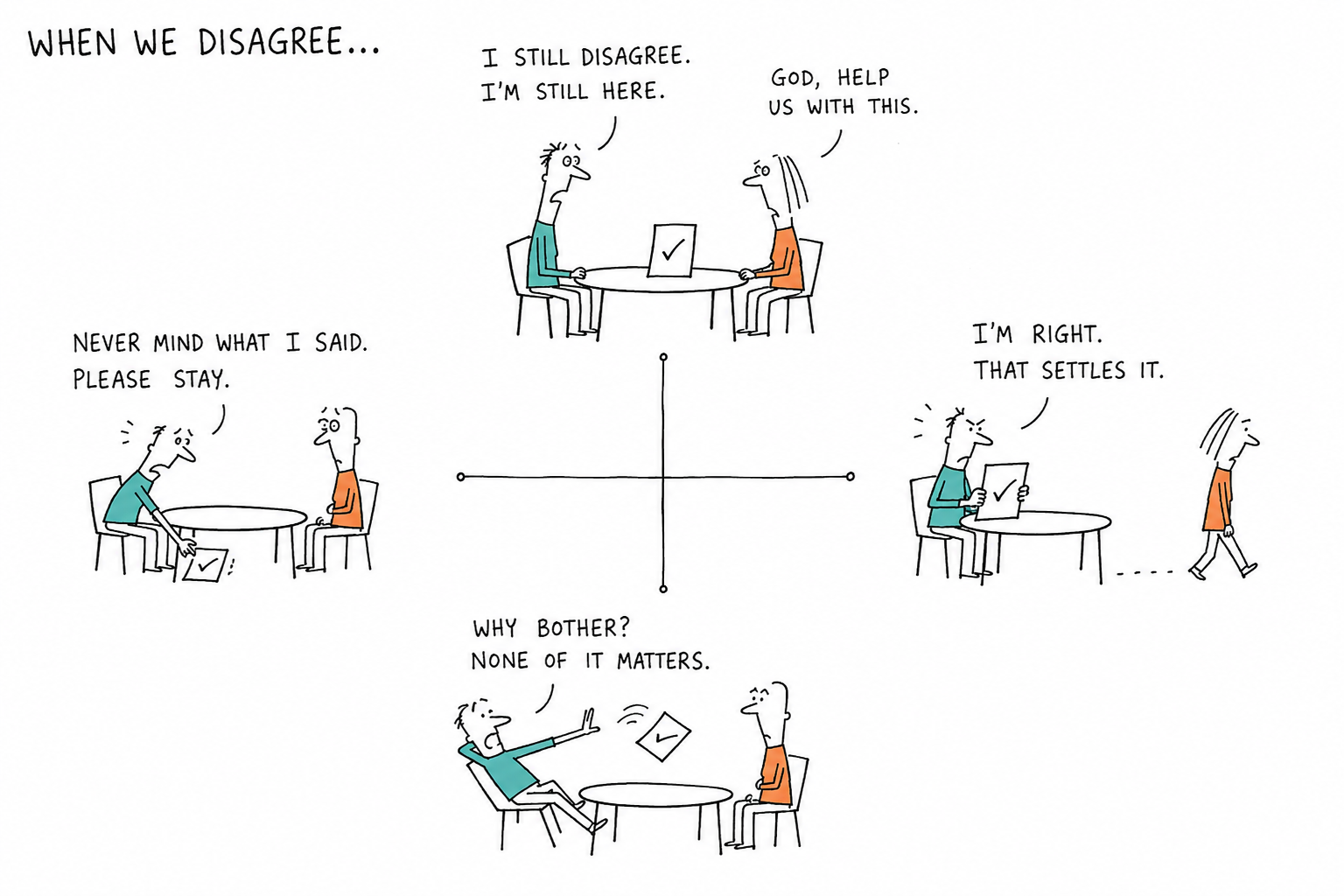
When we disagree: at the top, two people remain at a table with their conviction still present. One says, “I still disagree. I’m still here.” The other says, “God, help us with this.” At the left, someone puts conviction aside: “Never mind what I said. Please stay.” At the right, someone keeps the claim while the other person leaves: “I’m right. That settles it.” At the bottom, someone dismisses both the claim and the conversation: “Why bother? None of it matters.” These scenes illustrate responses we can move between, not fixed personalities or measured scores. The invitation is to keep right and relationship consequential and entrust unresolved tension to God.
A problem with actual people in it
Imagine a small business with an employee who has started missing deadlines while caring for a parent. This is a hypothetical example, but the obligations are ordinary enough. Customers have been promised something. Coworkers have their own work and families. The employee is trying to remain useful at work while somebody they love needs more than the evening hours.
The rule offers the manager a clean answer. Deadlines are deadlines. Everybody understood the arrangement. There is a legitimate concern for fairness in that answer, including fairness to people already doing extra work.
Compassion offers another answer. Give the employee room. People matter more than a schedule. There is a legitimate concern for the person in that answer, too.
Meanwhile, a coworker stays late again. The customer still needs the order. The parent still needs care. A moving speech about either accountability or compassion will leave most of Tuesday intact.
Right relationship requires us to stay with these people and their claims long enough to take responsibility for the next decision. We may have to change the work, share a cost, renegotiate a promise, or admit a limit. Whatever we do, it matters who disappears from our attention while we explain why we did it.
The good that organizes the room
People rarely experience their own position as an enthusiastic commitment to being awful. We usually have a good in mind. Justice. Mercy. Loyalty. Freedom. A promise that should mean something. A person who should matter.
The trouble grows when one of those goods becomes the only measure we will permit. People who organize around certainty can hear a plea for mercy as an attempt to make truth optional. People who organize around validation can hear a firm conviction as evidence that the speaker has stopped caring. Each side can become quite sure the other has abandoned the faith.
My framework begins with that organizing good, or plumbline. In the familiar collision between certainty and mercy, one person reaches for a dependable definition while another reaches for room to honor someone's experience. Other collisions organize around loyalty, freedom, purity, peace, or justice. We have to discover the actual good someone is protecting before placing their response on a chart. Both conviction and relational care give us something worth attending to. Either can become a way of relieving tension by surrendering an obligation that remains ours.
The vertical axis asks what we do with the increasing burden. We can become more engaged in holding right and relationship together. We can also spend enormous energy convincing ourselves that none of it deserves to matter.
That second movement can be furious. A person who has declared everything meaningless may have a surprising amount left to say.
Four names I find useful
I use nicknames because I remember people more easily than I remember labels. These names mark tendencies we can move through in a single conversation. Turning them into permanent names for our opponents would give us another way to stop listening.
Grampy George reaches for the certainty that will settle the matter. There is a right answer, and someone needs to insist on it. This can preserve something essential. The danger comes when the person becomes expendable to the answer. A boundary can protect a relationship. It can also relieve us of having to care what happens on the other side of it. We have to look at the particular boundary and its consequences.
Mr Davidson reaches for the room a person needs to feel understood and included. Here, the definition can bend so the relationship can continue. Sometimes we discover that our definition was poor, and the correction is overdue. Sometimes we keep bending until the promise means very little, or until other people's costs have become invisible. Being considerate does not settle which of those things we are doing.
Dr Jack offers relief by reducing the significance of the whole affair. Everybody is compromised. Every choice is terrible. Why keep pretending? Cynicism can protect us from another disappointment by making hope look embarrassing. It also gives us permission to stop being answerable for what happens next. Someone resting, declining an argument, or leaving a dangerous situation has not thereby made this move. What matters is whether people and obligations have ceased to count.
Uncle Ron accepts the increasing burden of keeping both right and relationship consequential. He permits the truth to remain demanding and the person to remain precious. He may have to say no. He may have to bear a cost nobody thanks him for bearing. He also has to live with an outcome he cannot guarantee.
I put Uncle Ron at the top of the chart because that movement asks more of us. The temptation is to turn the chart into a podium and imagine ourselves standing there. That would be a fairly efficient way to ruin it.
Where the burden goes
There is a small complication here. Everyone can learn to speak like Uncle Ron.
We can acknowledge complexity, affirm everybody's dignity, and end the meeting with a prayer. The language is available. The question is what remains consequential after we have used it. Does the person we affirmed get a hearing when their account threatens the decision? Does the truth we honored survive contact with the donor who would prefer a different truth? Who will carry the cost of our apparent maturity?
An agreeable tone can conceal a fairly brutal arrangement. A severe tone can come from someone who is still showing up, still paying the bill, still refusing to let another person's life collapse. Tone affects whether people can receive us, so it matters. It cannot do the entire job of discernment.
This is why I am cautious about using the framework to sort a room full of people. We have considerably more access to a person's behavior in one moment than to the history of their soul. Even the behavior needs context. A closed door may represent contempt, sleep, a confidential conversation, or a frightened person's first successful boundary. The photograph will look much the same.
The framework asks us to attend more closely. It loses its usefulness the moment it excuses us from that attention.
The Christian claim underneath this framework is that the demands of right relationship exceed our independent capacity. We need God. We need to be able to act faithfully without acquiring control over everybody affected by the action.
This is what I mean by lordship here. Jesus gets to remain Lord when the situation is unresolved, when obedience is expensive, and when somebody misunderstands us. We can bring Him the demands we cannot reconcile. Intercession gives us a way to remain involved with people whose lives we cannot fix.
There is still work to do. In that imagined business, somebody needs to make the call, change the schedule, or tell the customer the truth. Prayer cannot quietly assign the cost to the coworker who keeps staying late. Giving the burden to God includes remaining available for the part He gives us to carry.
Nor does dependence turn us into experts at this. We walk the line far more like drunks than drum majors. Yesterday's willingness does not prevent today's contempt. We can receive correction and try again without pretending the earlier failure was part of a flawless plan.
What staying in relationship can require
Return to the imagined employee with the parent who needs care. Suppose the business cannot absorb another month of missed delivery dates. The manager has checked the work, listened to the employee, and asked what might change. There is no secret reserve of capacity. There is still a person whose family is in trouble.
At this point, a framework promising a solution to every collision would become one more burden. It would imply that a sufficiently good manager could make all these demands fit. The manager might then hide the business's limits to preserve an image of generosity, or hide the employee's pain to preserve an image of competence.
A more faithful conversation can include a hard limit and a continuing relationship. Perhaps the role changes. Perhaps the employment ends and practical help continues in a different form. Perhaps the customer agrees to a delay. Each possibility has costs, and the people affected need to be able to tell the truth about them. None of those possibilities earns the Uncle Ron label by itself.
What matters is whether the manager keeps attending to the real obligations and people while making a decision that cannot please them all. A continued relationship may have to become less intimate. It may require witnesses, distance, or responsibilities held by someone else. The willingness to care cannot be measured by how much access a person is permitted to retain.
That distinction matters especially where someone has been harmed. Telling a harmed person to stay available to the person harming them can put spiritual language to dreadful use. Responsibility belongs to those with power to interrupt the harm, too. The framework does not assign all the tension to the person least able to refuse it.
Lordship gives us a place to entrust what remains beyond our control. It also prevents us from making our preferred arrangement sacred. Sometimes the relationship we must honor is the one our existing arrangement has been quietly spending.
What the framework lets us see
We can recognize a movement toward right relationship in someone who never names God. We can also hear religious language used to close a conversation that needed to remain open. The vocabulary alone cannot establish the posture.
God doesn't sign every sunset. Our inability to find a religious label on an act of care does not make that care unavailable to our attention. At the same time, recognizing the act does not tell us everything about the person's faith, motives, or relationship with God.
When I apply this framework to a headline, I want to know what the reporting actually supports. Who is being protected? Whose account is being dismissed? What would the speaker have to reconsider if the inconvenient evidence proved true? A political affiliation cannot answer those questions for us.
The accused person's rights and the injured person's dignity can both remain consequential. Evidence still has to establish what happened. The framework helps us examine our willingness to attend to that evidence, particularly when it might cost our preferred side something.
It also helps us notice a good act without writing an ending for it. Someone may protect an adversary's dignity and receive contempt in return. That does not erase what they did. We can celebrate the act while leaving the unfinished part unfinished.
A different use for a headline
A headline can supply the reassuring impression that all the world's confusion is happening among people less sensible than we are. We can read the day's failures, make our declarations, and arrive at dinner with our self-understanding undisturbed.
I am interested in a different possibility. A public conflict can make a familiar human movement visible at a scale we cannot ignore. We may notice someone defending an institution because admitting its failure would threaten belonging. We may notice someone treating another person's humiliation as evidence of justice. We may recognize the relief of declaring the entire system beyond hope.
Then the uncomfortable question comes home. Where have we asked the same thing of a smaller room?
The answer need not erase distinctions in power, responsibility, or harm. A manager's impatience and a government's abuse are not interchangeable events. A good framework can notice a similar movement without pretending the consequences are equivalent. It can help us take the larger wrong seriously while discovering something for which we can answer personally.
This is also where I hope our attention begins to make room for God. The world contains more than evidence for our disappointment. Someone may be telling the truth at a cost. Someone may be making room for a person they cannot excuse. Someone may be carrying an unresolved relationship in prayer instead of demanding that God endorse the easiest exit.
We can notice that. We can describe the particular action with care. We can allow another person's faithful act to complicate our account of what sort of world this is.
Bringing it closer
The framework becomes more useful when the person under examination is within reach of our own responsibility.
Consider one disagreement you are carrying. Give the good you are protecting a name. Then give the people affected their names. Look for the person whose disappearance would make your answer easier to defend.
Stay there a little. There may be something to correct, a cost to acknowledge, a boundary to make clearer, or a question you have been avoiding because you already know it will complicate things.
Bring that particular difficulty to Jesus. There may be enough light for the next act without enough light to explain the whole road. Right and relationship can both remain in your care while the outcome remains in His.