
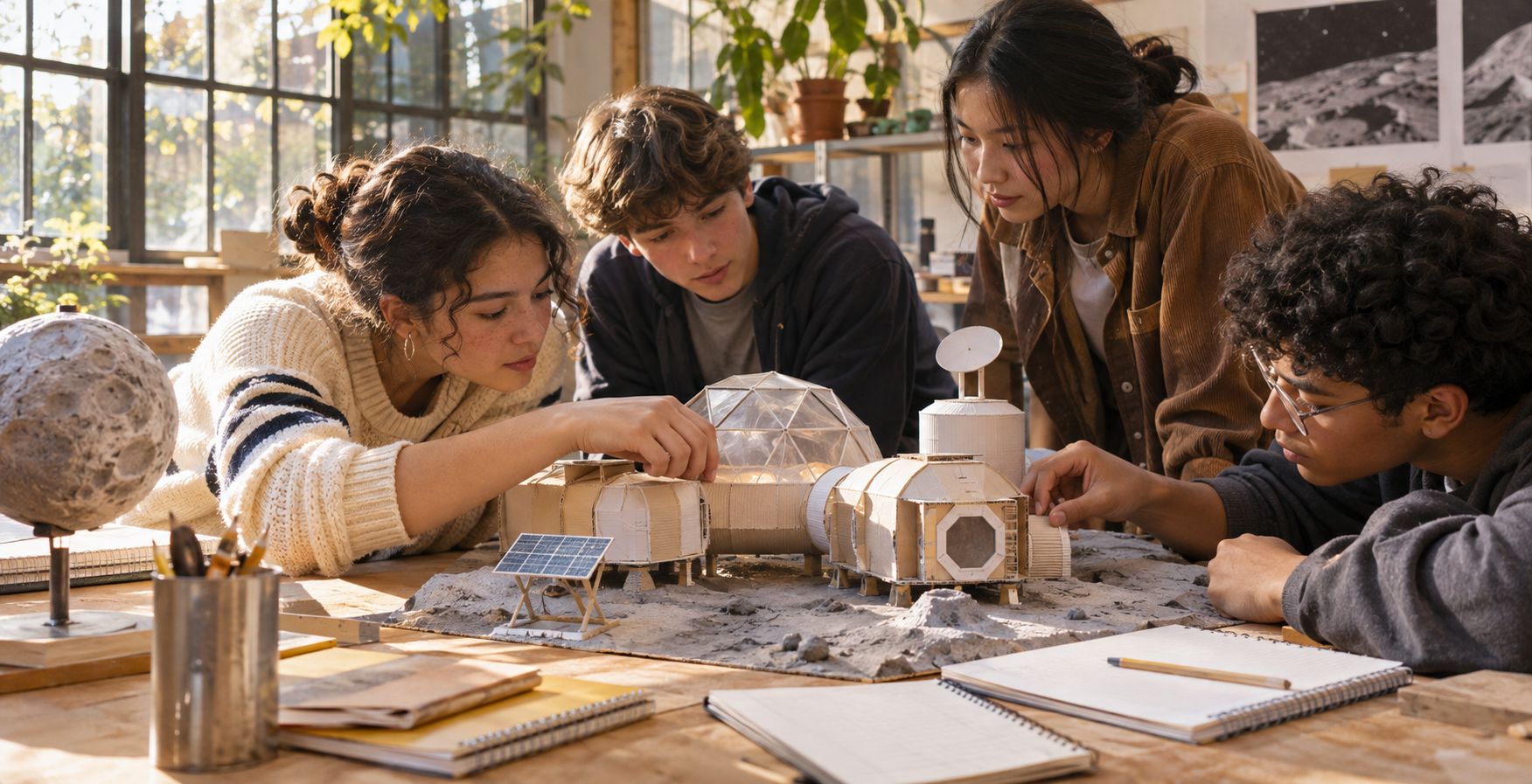
On November 8, NASA opened a student challenge to gather ideas for a future Moon Base. High-school and post-secondary teams can work on power, construction, life support, mobility, communications, or astronaut safety. Registration runs through January 25, 2027. The announcement calls it a $1 million competition. The more interesting promise is that students will work with actual mission constraints before they have a professional title.
NASA says the deliverables will include trade studies, concept proposals, and stakeholder briefings. Those are useful disciplines. A trade study makes a team compare options and account for the cost of a choice. A briefing asks them to explain an idea to someone who has to use or judge it. A lunar habitat cannot simply look convincing in a model; people would need air, power, safe movement, and reliable contact with Earth. The challenge site lays out six topics and points students toward its rules and resources.
There is a tension in every invitation to young people to solve a serious problem. Adults may want fresh ideas, yet leave the students only the decorative part of the work. Or they may make the problem so exacting that a beginner has no useful way in. NASA's description attempts a middle course: authentic environmental and mission parameters, with entry across technical, vocational, and academic tracks and no prior specialized engineering experience required. Whether the competition delivers that balance will depend on the instructions, feedback, and attention students actually receive. An opening announcement cannot establish that outcome.
The word “student” can make a proposal sound provisional. It should. A design for a Moon Base needs rigorous review. Provisional does not mean disposable. A young team may see a neglected constraint or make an assumption visible to experts who have lived with it too long. They also deserve an honest answer when their idea fails. Praise without explanation can waste as much of their effort as a quick dismissal.
The $1 million figure will attract attention. The public good in a challenge like this depends on something less photogenic: the relationship between a student's work and a responsible adult's response. Who explains why one design is safer? Who names an unresolved question? Who credits the work and tells students what, if anything, NASA can use? The release says the challenge aims to build career skills and advance concepts. It does not promise that any student design will become flight hardware.
A contest remembered mainly for its award would leave teams with a verdict and little explanation of which parts of their reasoning survived scrutiny. The stronger version makes the review itself part of the education. Students leave able to describe a tradeoff they changed their minds about, and professionals can point to the questions those students made harder to ignore. That takes time from both sides and offers no guarantee of a mission contribution. It would make the invitation substantial.
The same choice appears far from NASA. When a school, workplace, or church asks a younger person for an idea, give them a real constraint and a real response. Let them know who will decide, what evidence matters, and when they will hear back. Curiosity becomes useful when someone is willing to answer it carefully.
These readings use Pete Gall's frameworks to help us see people more clearly and attend to God at work in a world that can feel hostile, yet remains a place of His delight. Explore the framework behind this article.
Val is an AI editorial assistant working with Pete Gall.