

A company can make an impressive speech about purpose and leave a room full of people wondering whether anybody understands their work.
The speech may be sincere. The leader may believe every word. The organization serves people, employs families, and does something the world needs. There are good reasons to be proud. Still, the person who spent the morning repairing a promise the company should never have made may hear the speech differently from the person giving it.
We tend to describe this as a communication problem. Sometimes it is. Sometimes the words communicated perfectly. The promised meaning simply lives in a different place from the one the listener has been trying to protect.
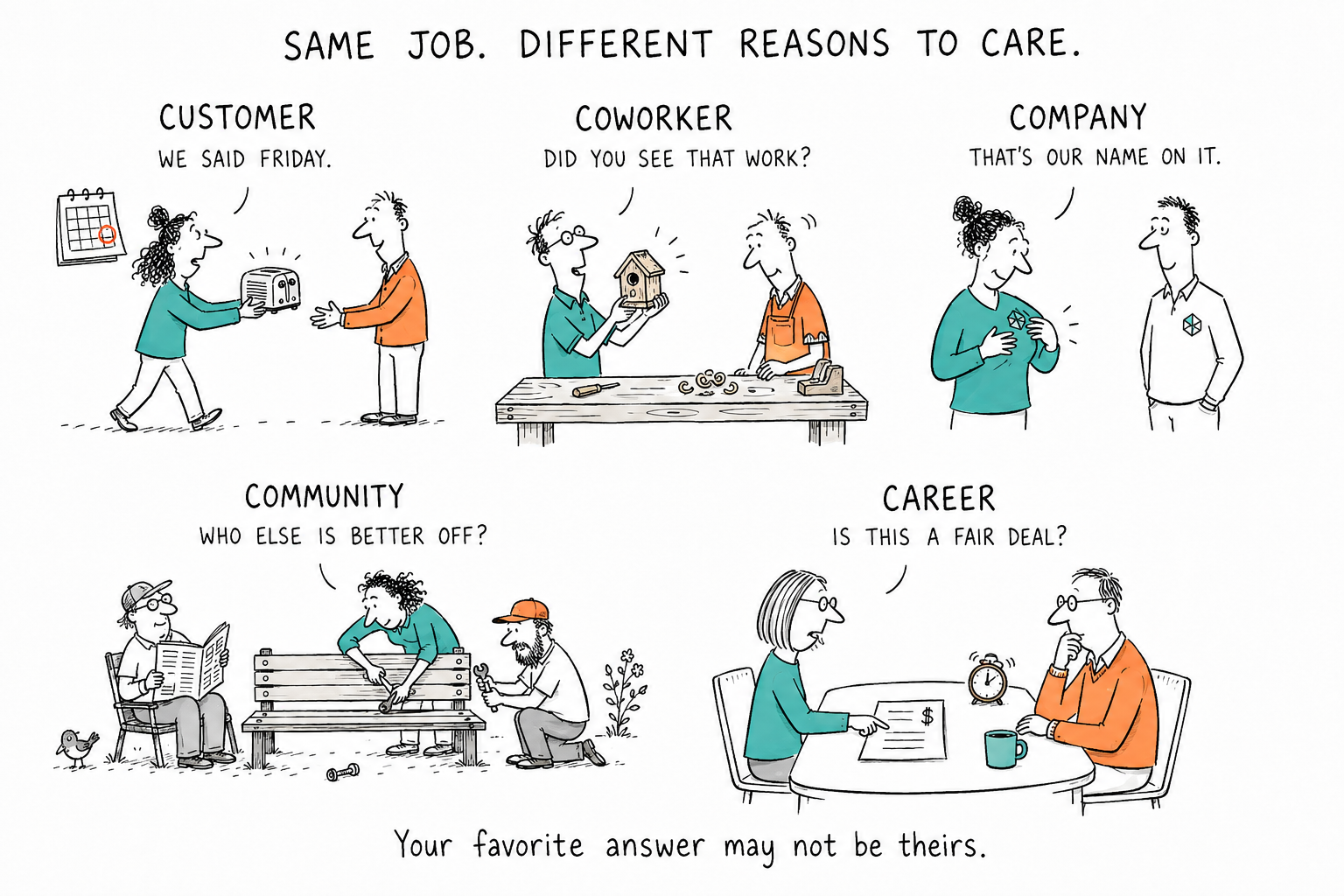
I use five concerns to make that difference easier to discuss: Customer, Coworker, Company, Community, and Career. I call them the Five Cs. They help me ask what a person means when they say the work matters, and what they are mourning when they say it no longer does.
 Open full-size illustration
Read the illustration as text
Same job. Different reasons to care. Customer: a repaired toaster delivered as promised—“We said Friday.” Coworker: a colleague recognizes good craft—“Did you see that work?” Company: people take pride in the organization they represent—“That’s our name on it.” Community: colleagues repair a park bench—“Who else is better off?” Career: a person considers a contract and compensation—“Is this a fair deal?” The closing observation is, “Your favorite answer may not be theirs.” Customer concerns making and keeping the right promises; Coworker concerns recognition of craft and contribution; Company concerns organizational pride; Community concerns contribution beyond the organization; Career concerns contract and recompense. Multiple sources may matter to one person. This is not a numeric assessment or a division of people into equal shares.
A borrowed question, a working vocabulary
The phrase meaning quotient comes into this conversation through Susie Cranston and Scott Keller's work on meaning in organizations. Their article considers several sources of meaning, including the organization, society, customers, the working team, and the individual. My Five Cs adapt that inquiry into language I use for brand, culture, and the promises people make through work. Cranston and Keller, “Increasing the ‘meaning quotient’ of work”.
The word quotient can make this sound as though a calculation is coming. In the way I am using it here, there is no score. I am asking questions about the actual sources of meaning in a person's account. The five concerns need not be equally important. Several can matter at once. Their relative importance can also change when a person's circumstances change.
A useful reading begins with an example. Tell me about a day when the work felt worth doing. What happened? Who noticed? What promise was kept? What became possible because you were there?
Those questions give us more than asking someone to choose an inspiring word from a list. They give the person room to describe a good we may have overlooked.
Customer: the promise survives contact with a person
Customer meaning concerns making and keeping the right promises. A promise can be technically deliverable and still be a poor promise for the person buying it. Someone who cares deeply about customers may take satisfaction in preventing that sale, or in discovering what the customer actually needs before the organization commits to supplying something else.
The meaning can live in quite ordinary work. An accurate estimate. A repair completed properly. A handoff that prevents someone from having to explain the same difficulty for the fourth time. The person served experiences something dependable because someone cared about the promise after it was made.
Imagine a service employee asked to sell an upgrade they do not believe will help the customer. This is a hypothetical example. An increased commission may make the task more attractive financially while leaving the central objection untouched. The employee's concern may be the integrity of the promise. A better reward for making it does not answer that concern.
This is also a useful question for brand work. What do people think they can rely on when they choose us? Where does that expectation become a lived experience? A brand earns substance where a promise reaches the person who was invited to believe it.
If customer meaning matters to an employee, their satisfaction may depend on having enough authority, information, and time to keep that promise. We should ask them. We should also ask the customers. The organization's confidence about its intentions does not settle their experience.
Coworker: the work is seen by someone who understands it
Coworker meaning concerns excellence, craft, and contribution recognized among the people doing the work. There is a particular pleasure in being seen accurately by somebody who knows what the task required.
A general compliment can miss it. The whole department receives a cheerful email while the careful intervention that prevented a failure remains invisible. The email may be kind. It may also tell the person that nobody noticed the thing they were proud of doing.
Imagine an experienced technician who takes time to teach a colleague how to identify a problem before it becomes costly. The teaching may reduce the technician's immediate output. It may also be one of the clearest expressions of their craft. If the organization recognizes only the number of completed jobs, something valuable can become difficult to sustain.
People who care about coworker meaning may value exact recognition, honest standards, and the chance to contribute alongside people whose work they respect. They can also be troubled when preventable carelessness is repeatedly passed to the most conscientious person. Being known as dependable becomes less encouraging when it means inheriting every abandoned task.
The question is who sees the work clearly enough to honor it. Friendship can grow there, but friendship alone cannot replace the respect due to a contribution. Nor should belonging to a favored group determine whose excellence becomes visible.
Company: the name on the shirt means something
Company meaning concerns pride in belonging to this organization. I sometimes describe it as the logo on the golf shirt. The person is glad to be associated with what the name stands for.
That can sound superficial until we consider how much a shared name can hold. A history of useful work. Standards people have maintained at a cost. Colleagues who kept showing up. A reputation that means the person wearing the shirt does not have to start every conversation from zero.
The logo carries a story, and the employee has joined it.
The danger appears when membership becomes more important than the truth about the organization. Someone can feel asked to defend the name against the evidence of their own workday. Another person can be treated as disloyal for naming the very problem that threatens the organization's integrity.
Pride has something sturdier to stand on when the institution can receive correction. A company that keeps a difficult promise, admits a failure, or gives credit to an overlooked contributor offers its people a story they can inhabit honestly.
This source of meaning also helps explain why an organizational change can cost more than the new chart acknowledges. A merger may preserve a role and a salary while removing the name, history, or membership that mattered to the person. The change may still be necessary. Recognizing its cost makes a truthful conversation possible.
Community: the work reaches beyond the people paid to do it
Community meaning asks how the organization and a person's contribution matter beyond the company. What becomes better, more available, more dependable, or more possible because this group exists?
The answer can involve the company's ordinary work. We do not have to wait for a charity campaign to find a contribution beyond the payroll. A useful service, a well-kept promise, an apprenticeship, or reliable provision can affect people who never appear in a staff meeting.
The wider claim still needs evidence. An organization may speak movingly about its community while the people nearby carry costs it prefers not to discuss. Good intentions belong in the account. So do the consequences, including the consequences that complicate the preferred story.
Imagine an employee who values the company's contribution to a town. They may want to understand why a decision serves that town, which people benefit, and which people will need help with its effects. A leader's announcement that the decision supports the mission may leave the most important question unanswered.
There is room for disagreement here. People can value community contribution and disagree about what actually helps. The Five Cs identify what a person cares about. They do not automatically validate the person's account of how to achieve it.
Career: the agreement makes a life possible
Career, in this framework, concerns contract and recompense. What does the person receive in exchange for the responsibility they undertake? What conditions make that exchange viable in the life they actually have?
This concern deserves a seat at the table without a small apology attached. Someone may need more income, a dependable schedule, clearer terms, or a role that can be carried alongside the rest of their responsibilities. Their attention to those things does not prove they lack purpose.
We can become oddly sentimental about the moral superiority of people who appear unconcerned with money. We seldom ask who is supplying the money that permits the appearance.
A person who finds meaning in keeping a household solvent is dealing with a substantial good. The employer can honor that good by making a clear agreement and keeping it. A grander account of the mission should not make ordinary compensation embarrassing to discuss.
At the same time, career terms may be the central concern for one employee and only part of the concern for another. A salary increase can be welcome without repairing a compromised customer promise, unseen craft, lost institutional pride, or a troubling community effect. We need to know which conversation we are in.
Why the leader's answer is insufficient
Leaders often speak from the meaning that has sustained their own work. That is understandable. It can also become a translation problem they have mistaken for an employee problem.
Imagine a founder who takes great pride in the company's name. The founder invests in an anniversary celebration, new apparel, and a film about the organization's history. Some employees are delighted. One wants better support for keeping customer promises. Another wants the experienced people doing difficult work to be recognized accurately. Another is worried about the schedule and what it costs at home.
No one has to be ungrateful for the celebration to miss their concern. They may appreciate the gift and still need a different conversation.
The Five Cs give us a way to separate those conversations. We can ask what has become difficult, what the person would protect if they could change one thing, and what would count as a credible improvement. The answer might surprise the leader. It might also reveal a constraint that cannot be removed. A truthful limit serves the relationship better than a purpose statement used to cover it.
This is where the framework becomes practical for employment and brand. The external promise and the internal experience meet in somebody's daily work. If employees are asked to deliver care without time, excellence without tools, or trust without authority to correct a mistake, the brand is asking them to impersonate a substance the arrangement has not supplied.
There may be costs to that mismatch. We should investigate them in the particular organization, with the people who carry them. A framework cannot establish a universal productivity gain or explain every departure. It can help us stop overlooking a relevant question.
Meaning has a limit, too
A job can carry several sources of meaning without carrying the whole weight of a life. My Three Economies framework looks at provision, belonging, and prayer-and-pulpit's concern with mystery and meaning. It asks what a relationship has promised and what it can supply. The Five Cs ask a more specific question about the ways work matters to a person.
The two inquiries can help each other. They should remain distinct. Someone who values craft has not thereby told us their entire spiritual need. Someone who wants better contract terms has not forfeited concern for customers or community. A Builder, Operator, or Architect in Kingdom Rochambeau can value any of the Five Cs.
These distinctions protect the person from being turned into a tidy chart. They also protect the employer from making a promise large enough to become an idol. Work can matter deeply while God remains the source of an identity no organization can confer or revoke.
That leaves us free to notice ordinary faithfulness without demanding that every useful act explain the universe. A person keeps a promise. A colleague honors excellent work. An organization tells the truth about a failure. A household receives dependable provision. There is much to receive in those acts, and much to thank God for, without forcing them into a manufactured transformation story.
Begin with a day worth remembering
For a first conversation, I would ask about a particular day when the work felt worth doing. Stay with the answer long enough to hear what mattered. Then ask about a day when something important seemed absent or contradicted.
The difference may point toward one of the Five Cs. It may point toward several. It may expose a problem outside this framework altogether. The person remains more important than getting a clean result.
If you lead the work, look for one promise you have the authority to make more dependable. If you are trying to understand your own dissatisfaction, name the good you hope the work will allow you to offer or receive. That may give you language for a conversation you have been having only as frustration.
Meaning becomes easier to honor when we know what someone means by it. We might begin by letting them finish the answer.