

Imagine receiving a performance review at the family table. Your contributions have been noted. Several are appreciated. There are concerns about consistency, however, and the household will need a more compelling demonstration of value before renewing your belonging for another year.
We would recognize something wrong with that arrangement, even if the review were accurate. A family can need an honest conversation about responsibility. Belonging involves obligations. Still, the child at the table should not have to negotiate existence as a useful household asset.
Now turn the situation around. Imagine accepting a job and being told that employment here is a family bond. The language is warm. The relationship has become large enough to explain a late night, an extra assignment, a missed vacation. Then a difficult quarter arrives, and the bond turns out to contain a termination clause.
The agreement may permit the decision. The earlier promise may have encouraged a different understanding.
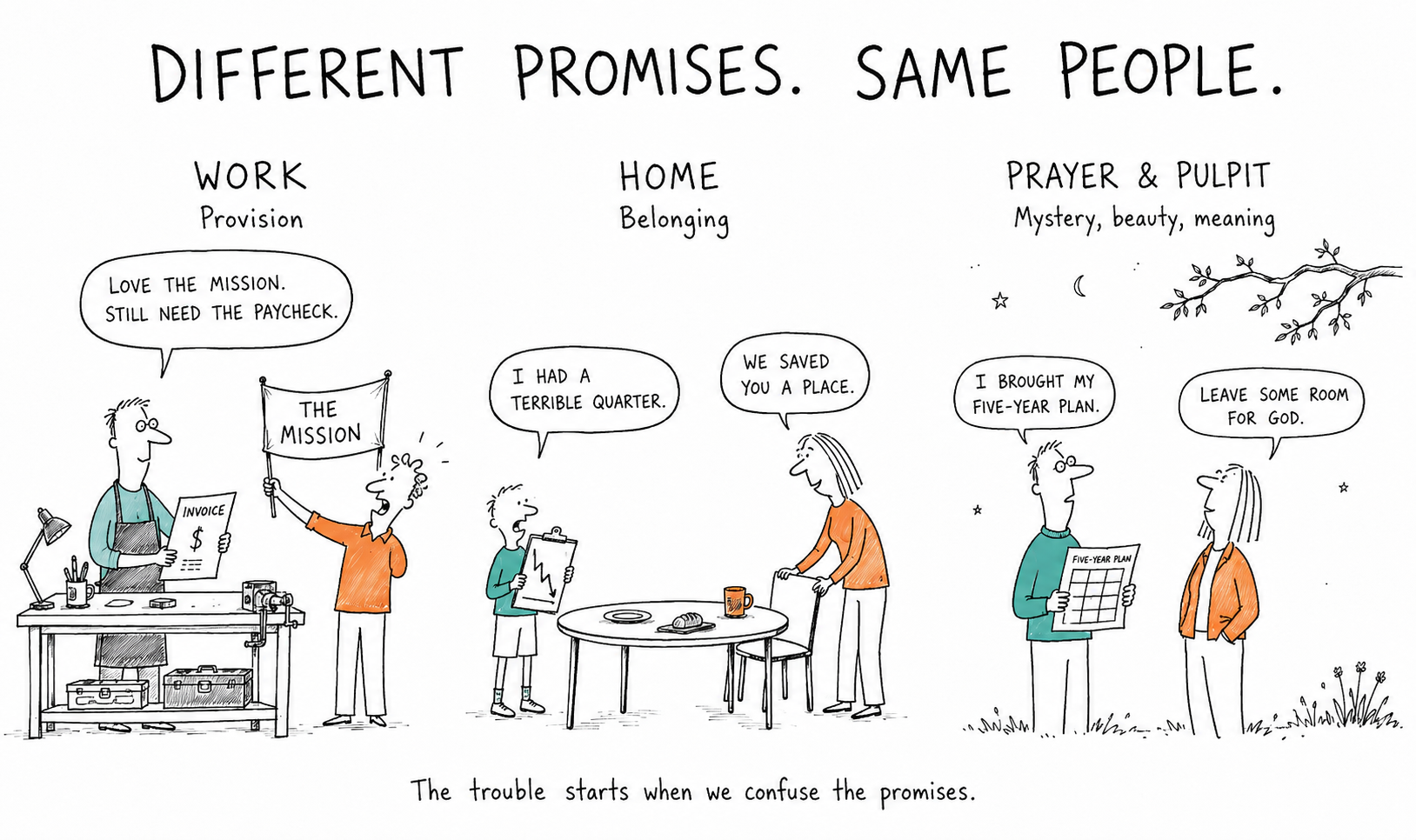
I use a framework called the Three Economies to look at these collisions. What are we asking a relationship to provide? What has it actually promised? And what happens when we import the expectations of one part of life into another, then become angry when the exchange cannot bear them?
 Open full-size illustration
Read the illustration as text
Different promises. Same people. Work—Provision: a worker holding an invoice says, “Love the mission. Still need the paycheck.” Home—Belonging: a child with a performance chart says, “I had a terrible quarter.” A parent replies, “We saved you a place.” Prayer and pulpit—Mystery, beauty, meaning: beneath an open sky, one person says, “I brought my five-year plan.” Another replies, “Leave some room for God.” The closing observation is, “The trouble starts when we confuse the promises.” These are kinds of relationship, not exclusive buildings or roles. Meaningful work can include belonging, and ministry employment still includes work agreements.
Three kinds of need
The framework grows from my engagement with David Whyte's The Three Marriages, which considers work, self, and relationship. My home, work, and prayer-and-pulpit language is an adaptation with its own Christian emphasis. Those economy names and the role connections I use are mine, and should be read that way. David Whyte's book.
By an economy, I mean an arrangement of expectations about giving and receiving. Money is one part of one of these arrangements. The larger question is what counts as a fitting exchange and what makes a claim legitimate within it.
Work supplies provision through agreements, roles, transactions, and recompense. We undertake responsibilities. Someone relies on the work. We receive something in return. Even a generous workplace needs to be able to say what is being promised and what the arrangement can sustain.
Home supplies belonging that reaches beyond current usefulness. People have a claim on our care because they are ours to love. They may be inconvenient, unproductive, ill, confused, or going through a season in which their contribution is mainly additional laundry. Their value survives that season.
Prayer and pulpit names our relationship with mystery, beauty, and meaning. There is more to being alive than the terms of an agreement or the security of having a place at the table. We want to know what our lives belong to. We can be well compensated, deeply loved, and still find ourselves awake with that question.
The economies are distinguishable even when they meet in one person on one ordinary afternoon. We need provision, belonging, and meaning. Trying to shame one need out of existence generally hands it to another relationship in a less recognizable form.
The dignity of an agreement
Work can suffer in these conversations because a transaction sounds smaller than love. There is plenty of undignified commerce in the world. There is also dignity in making a clear promise, doing the work, and paying what was agreed.
A person can provide for their family through work whose grand purpose does not stir them. They may still do it with skill and integrity. We should be cautious about treating their arrangement as a spiritual disappointment. The provision is real. The people sustained by it are real.
Conversely, meaningful work can make legitimate claims on us. Someone may love a craft, believe in a service, or care deeply about the people it reaches. That does not make the work economy an error. Meaning and provision can inhabit the same job. The difficulty comes when the promise quietly expands beyond what the people involved have agreed to provide.
If an employer promises a wage for a defined responsibility, calling the work a calling cannot settle an unpaid bill. If an employee accepts a role, a lack of daily inspiration does not automatically release them from the responsibilities they accepted. Both sides deserve the truth about what has been offered and what has changed.
A good agreement gives generosity something solid to stand on. When the ordinary obligation is clear, an additional gift can be recognized as a gift. When everything is described as devotion, it becomes difficult to tell whether anyone was allowed to decline.
This is especially important for the person with more power. A leader's passing hope can sound like an assignment to everyone who depends on that leader for income. Warmth does not erase the payroll relationship. It makes clarity more necessary.
The belonging we cannot manufacture at work
There are workplaces where people love each other. They show up at funerals, bring meals, celebrate children, and stay in touch long after an employment agreement ends. We can welcome those friendships without pretending a company can guarantee them.
The phrase we are a family can mean several things. It may express affection. It may describe the owner's actual relatives. It may be a clumsy attempt to say that people will be treated as people. It may also be used to claim a level of loyalty the institution cannot return.
The slogan alone cannot establish which of those things is happening. Look at the promise and the cost. Can someone decline an extra assignment? Can they leave without being treated as disloyal? What happens when their usefulness diminishes? Does care continue where the contract ends, and who has actually undertaken to provide it?
Home also needs this examination. Belonging that exceeds performance does not mean that everything a family member does must be permitted. A household has obligations to the people being harmed by another person's behavior. Boundaries can make continued care possible. A family can ask for help, name a limit, or change an arrangement while continuing to regard the person as precious.
The economy becomes distorted when affection is paid out as a reward for usefulness, or when belonging is invoked to erase everyone else's limits. The same person can be wronged by one distortion and participate in the other.
This is one reason the framework needs actual relationships in it. Home is a name for a kind of belonging we need. It is not evidence that every household has supplied it. We can honor the need while telling the truth about the place where it was missed.
What the mystery is allowed to remain
The prayer-and-pulpit economy is where our useful explanations begin to run out of authority. We can ask about a life's efficiency and still have no account of its beauty. We can explain how a person survived and remain unable to say why their life matters so much to us. We can have an adequate reason to continue living and still ache to be called by name.
I use the phrase irrational mystery here to describe what exceeds a transaction or a fully manageable explanation. It does not require us to abandon reason. A beautiful thing need not become a business case before it is permitted to matter.
Prayer is one way of remaining present to God while the explanation remains incomplete. In worship we can delight in God after an unproductive week. A pulpit, at its best, can help us attend to a meaning larger than the institution from which the words are spoken.
That last distinction deserves some care. A church is a real institution with buildings, staff, responsibilities, and bills. It needs the work economy to function honestly. It may also host relationships of profound belonging. Its spiritual vocabulary cannot make those arrangements unlimited, and its organizational needs cannot acquire the authority of God simply by appearing in a sermon.
When loyalty to God and availability to an organization become indistinguishable, the organization has made a very large claim. People can become afraid that an ordinary limit reveals a spiritual failure. The practical question is: What have I actually agreed to do, and who is asking for more?
God is not diminished by a clear volunteer schedule. He does not need confusion about an employment agreement to preserve the mystery of His presence.
One building, several relationships
Imagine a church employee whose spouse is ill. The employee is also a member of the congregation and a friend of several colleagues. The staff needs work completed. The household needs care. The employee may need prayer, practical relief, and an honest conversation about what can still be done.
This is a hypothetical situation, with several economies present at once. The church building tells us very little about which expectation is governing a particular exchange.
A supervisor can discuss the role's responsibilities. A friend can bring a meal. A pastor can pray. Those actions may be offered by the same person, but the person still needs to know which relationship is speaking. A pastoral conversation that quietly becomes a performance evaluation can make future honesty very difficult.
Likewise, a staffing shortage cannot be resolved merely by affirming how much everyone belongs. Someone has to name the work, the capacity, the limits, and the available options. Care may require changing a promise. It may require paying for help. It may require admitting that a program cannot continue in its present form.
The framework can help the people involved stop making one need disappear inside another. Provision remains consequential. Belonging remains consequential. The presence of God remains available without becoming a guarantee that every existing arrangement will be preserved.
The need we ask everyone else to share
In Kingdom Rochambeau, I describe three recurring orientations: Builder, Operator, and Architect. I see natural affinities between Builder and the work economy, Operator and home, Architect and prayer and pulpit. These are affinities, rather than exclusive assignments. Every role remains a whole person with needs in all three economies.
The affinities can help us ask a question about an expectation that has become unusually heavy. An Architect may ask every job to supply a compelling assertion of meaning. An Operator may feel both attracted and betrayed by the company's offer of family. A Builder may assume that everyone should be as fastened to the work as the person whose history, resources, and identity are bound up in it.
Those are patterns to investigate with someone. We cannot read a title or hear a slogan and know the answer. A worker's dissatisfaction may concern an actual broken promise. A leader's intensity may be appropriate to a real crisis. The framework has to remain open to the particulars that complicate its first impression.
Its most useful question may be the least flattering one: What do I keep asking another person to supply because I have not admitted how much I need it?
The employer cannot become the family we never had by improving the benefits package. A spouse cannot establish the ultimate meaning of our existence by becoming more attentive. A church cannot relieve every anxiety about provision by speaking more confidently about purpose. Each relationship can offer real good. Each also has an edge.
Recognizing a relationship’s limits can be sad. It can also help us appreciate what the people involved are able to offer.
A more truthful expectation
Consider one place where disappointment keeps returning. Begin with the actual promise. If possible, give it the words that were used. Then ask what you understood those words to mean. There may be a difference between the agreement on paper, the atmosphere around it, and what you hoped would happen.
That difference does not establish who is at fault. It establishes a conversation worth having.
Someone may need to acknowledge an inflated promise. Someone may need to grieve an expectation the relationship never agreed to bear. There may be a practical change to make, a boundary to state, or a need to seek help somewhere else. A clearer account of the economy should increase our responsibility for the good we can actually offer.
I hope it also makes us more attentive to the gifts that exceed an agreement. A colleague becomes a friend. A family member notices work no one else understood. A moment of beauty interrupts the machinery of a difficult day. These things can be received without turning them into the new minimum someone must deliver forever.
We can ask a job for honest provision, a home for belonging, and God for the meaning we cannot manufacture. His generosity may reach us through all three, sometimes in a form we would have missed while demanding a different one.