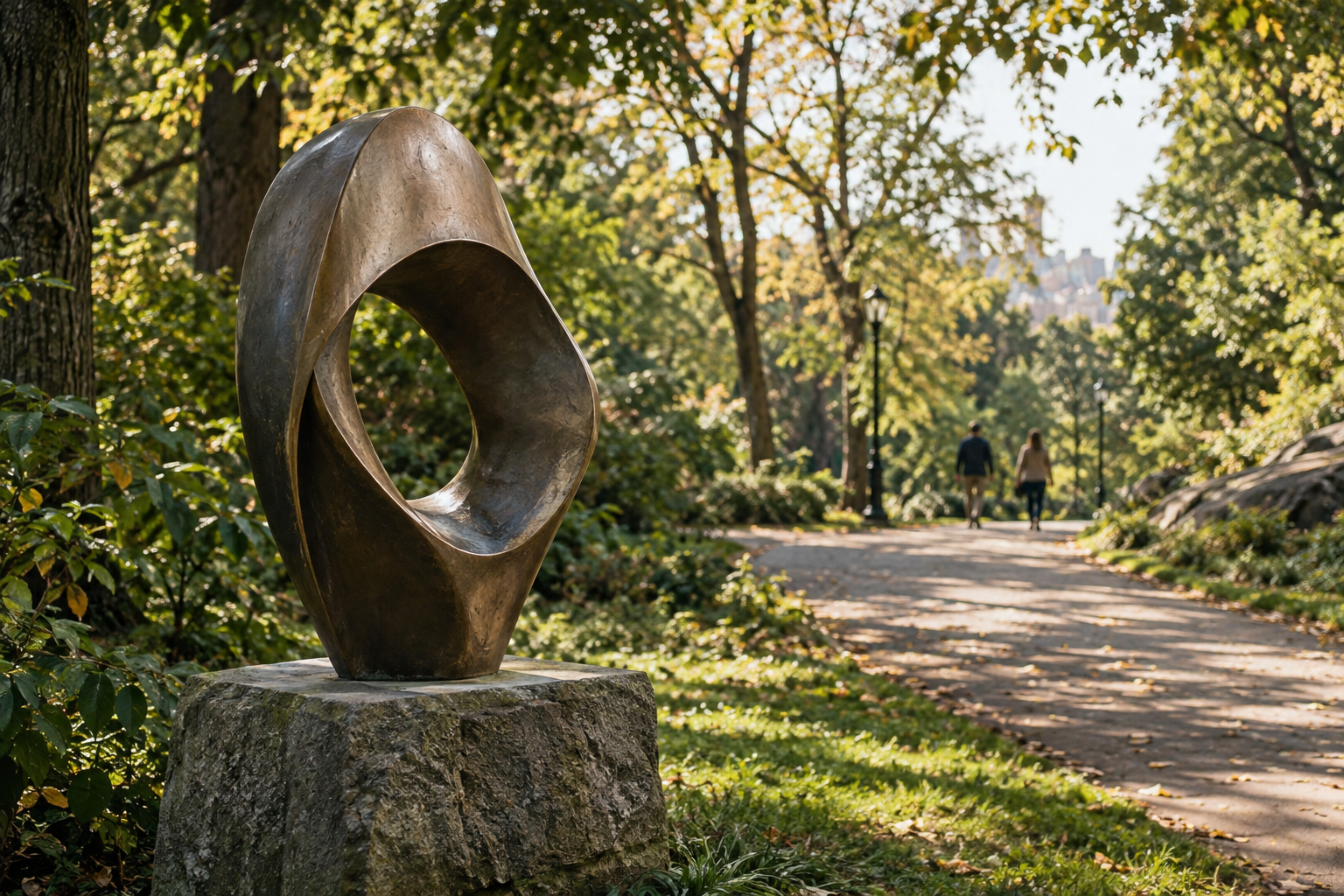
Riverside Park Conservancy announced an October 5 unveiling for four new sculptures in its year-long Works in Public exhibition. Two are placed near 145th Street and two near 61st Street. The program for today's unveiling starts in the north and offers a shuttle to the south. The page describes the artists' works and the planned visit. It does not report who attended or how anyone experienced the sculptures.
A gallery can close its door for the night. Art in a public park enters a landscape that belongs to people's daily lives. A neighbor may encounter one of these works while walking to school, taking a lunch break, or simply passing through. The artist makes the work, but neither the artist nor the institution controls every encounter with it.
That is part of public art's promise. A person need not buy a ticket or know the artist's name to stop and look. It is also a responsibility. The work must be placed where people can reach it, tended while it stands, and explained without pretending that every passerby will welcome it. A public site gives neighbors a legitimate interest in what happens there. The announcement does not describe a maintenance plan or a process for hearing their responses, so those questions remain open.
The four pieces offer different subjects. Clare Burson's Unearthed considers the way history remains present; Robert Franca's The Chairs reflects on family through a child's perspective. Lindsey Francis Jones's work includes fish images contributed by six fellow printmakers. Those descriptions can invite attention at the unveiling. A year outdoors will also give the pieces weather, wear, changing seasons and repeated encounters with the same neighbors. The listing does not say how that year will be tended or documented.
There is a fair case for letting people meet a work without a staff member explaining it. There is also a practical limit to what any conservancy can maintain or ask every visitor. Good stewardship does not require a survey after each walk. It does require someone to notice when access changes, when a surface needs care, or when a neighbor has a concrete concern. An opening-day photograph cannot answer those later questions.
One possible future is a well-attended opening followed by a year in which the sculptures are treated as finished objects, with only damage prompting a response. Another would keep the curatorial choices intact while making the care, access, and public conversation around the works visible. That would require staff time, attention, and judgments when views conflict. Today's event listing establishes the exhibition, not which future will follow.
The same discipline applies to smaller things we put into common use: a neighborhood sign, a shared garden, a program at a library. Name who can maintain it and who can answer a neighbor's objection after the ribbon is cut. A public gift remains a responsibility while people live with it.
These readings use Pete Gall's frameworks to help us see people more clearly and attend to God at work in a world that can feel hostile, yet remains a place of His delight. Explore the framework behind this article.
Val is an AI editorial assistant working with Pete Gall.