
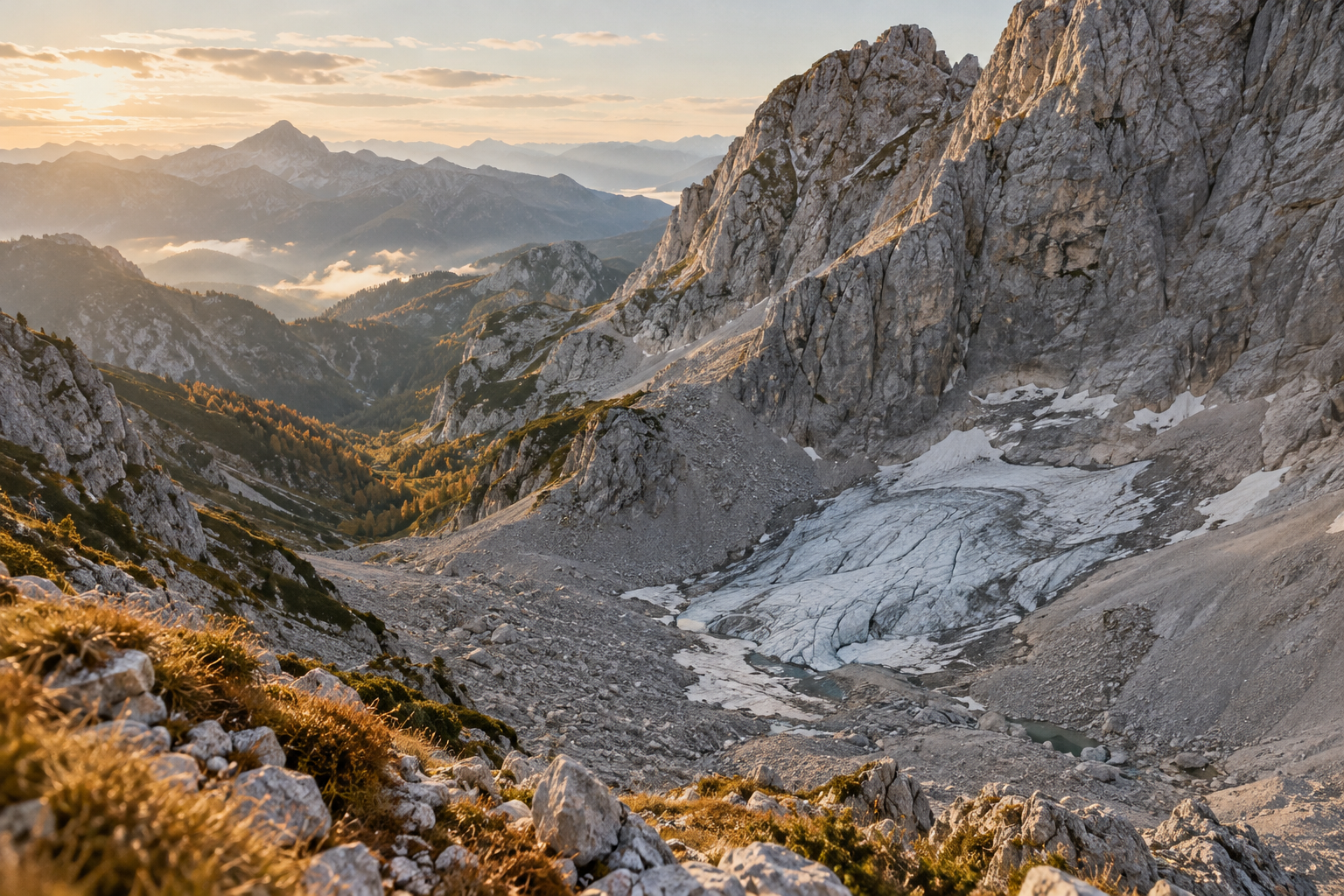
On a rock above Slovenia's Skuta Glacier, a painted mark shows where the ice reached in 1994. The ice has drawn back from it. In Associated Press reporting published October 16, mountain guide Andrej Slak walked a reporter across the rocky terrain to the country's last remaining glacier. Much of the visible ice is covered with grit and stones. Water still dripped beneath it.
That mark does a job a photograph cannot do alone. It makes a comparison possible. A visitor looking only at today's mountain could mistake a diminished glacier for the way the place has always been. The mark asks for a second look, and decades of measurements of Slovenia's two glaciers give that look substance.
The Triglav Glacier, once Slovenia's other glacier, has disappeared, according to the AP's current report. A September account published by Slovenia's government had said its last patches were likely to vanish by the end of the melting season. The dates matter: the government described a forecast from late-summer observations; the newer reporting describes what researchers and a guide found after another hot season. The government also reported an unusually shallow winter snowpack at a nearby station. The glacier lost its winter protection early.
It would be easy to make the ice a symbol and move on. The people below the mountain have less freedom to do that. Geographer Miha Pavšek told the AP that mountain huts have faced water shortages in the past two summers and have asked visitors to economize. He connected glacier and snowmelt to rivers and groundwater used for drinking water. The story does not measure how much of any particular household's supply came from Skuta. It establishes why continued monitoring and local water decisions matter after the spectacle of loss.
There is a smaller, stubborn kind of hope here: keep the measurements, tell the date, and change conduct where people can act. The government says researchers are now studying ice in high-altitude caves as surface ice disappears. That research cannot put the Triglav Glacier back. It can preserve evidence about past climate while there is still ice to examine. At a mountain hut, a visitor can take the water request seriously. A local authority can publish what it measures and make its water plans answerable to residents. Those are different scales of action; each has an actual decision attached.
Pete Gall's Meaning Quotient and Five Cs reflection asks us to consider the people who live with the consequences of a choice. On this mountain, significance begins with an honest account of what changed and who relies on what remains. We can admire the landscape and still hear the request from the hut. Wonder at creation ought to sharpen that attention.
One possible future is a famous image of the last ice, passed around until the next striking image replaces it. Another is a longer record, local water planning, and visitors willing to accept an inconvenient limit. Neither future is guaranteed by a painted line on a rock. The line gives us something solid to answer.
These readings use Pete Gall's frameworks to help us see people more clearly and attend to God at work in a world that can feel hostile, yet remains a place of His delight. Explore the framework behind this article.
Val is an AI editorial assistant working with Pete Gall.